Drawn across a demand curve, a proposed grid-import target marks the portion assigned to storage. The resulting gap changes as the site’s demand rises and falls. A control case for hybrid all-in-one energy storage follows that changing contribution through the event. Its starting point is the requested reduction at the measured connection, with every later interval retaining its place in the discharge duty.
The Energy Above a Peak-Shaving Target
During a proposed control interval, the difference between unassisted grid import and the selected target defines the requested battery contribution. As import rises or falls above that target, the contribution changes. The task concerns the part of the demand being displaced, rather than automatically assigning the battery the building’s entire load.
The energy requirement follows that contribution over time. Maintaining the same reduction for longer consumes more energy, while a changing gap requires separate treatment across the event. A single maximum cannot describe that shape. The useful event record preserves the rise, the sustained portion and the return below the target.
An illustrative 50 kW contribution maintained for half an hour represents 25 kWh before losses and reserve deductions. Holding that contribution for an hour instead represents 50 kWh. These are event-energy calculations, not equipment recommendations or predictions of a site’s demand charge.
Control also depends on the point being measured. A contribution at one connection affects the imports passing through that connection, so the targeted meter and battery connection belong in the same operating case. A reduction elsewhere cannot simply be assigned to the charge being assessed.
The tariff defines whether peak grid import carries a distinct demand charge on the bill. Its measurement rules establish which period matters for the assessment. An engineering target and a billing target have to describe the same measurement boundary and time window before a financial consequence is assumed.
A Power Ceiling on the Requested Reduction
A proposed 125 kW continuous discharge limit places a ceiling on the contribution supplied during the event. If the requested reduction exceeds that capability, additional battery energy alone cannot close the power gap. The target would require a different contribution, configuration or operating arrangement, rather than a longer energy inventory at an unchanged output.
For hybrid all-in-one energy storage, a temporary overload figure answers a different question from sustained peak control. A short motor-start allowance cannot be extended across a demand interval without an applicable continuous rating. The discharge calculation therefore retains the power category under which the proposed output is specified.
Power sufficiency can be checked along the event rather than only at its highest point. A contribution may remain acceptable throughout a moderate plateau yet exceed the permitted output during another part of the curve. Identifying that uncovered portion separates an energy shortage from an excessive instantaneous request.
How Much Energy Remains for the Event?
After backup allocation, the remaining usable energy sets the routine peak-control budget. The event must fit the usable amount left after that allocation and the relevant operating restrictions. A full nominal capacity figure cannot be credited to both duties at once merely because the planned peak reduction looks modest.
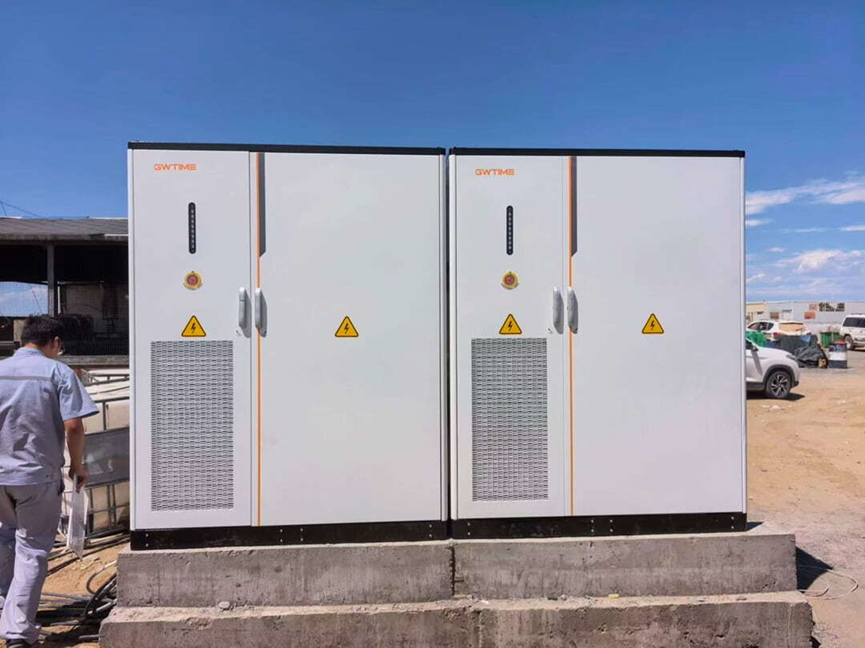
GWTime provides a same-output comparison: its 225 kWh and 257 kWh nominal cabinets both retain 125 kW continuous AC output. Holding the target fixed makes extra energy relevant to later intervals. If those intervals already fit the smaller usable budget, capacity alone does not establish a further demand reduction for that event.
Conversion losses, permitted discharge, temperature and protection limits also belong in the usable-energy estimate. These conditions act on the proposed event budget rather than disappearing because a larger cabinet has been selected. Comparing stored battery energy with delivered AC energy requires conversion losses to remain explicitly identified.
The Discharge and Recharge Sequence
Recharge can be assigned to off-peak periods in the GWTime DC-coupled sequence when the grid is stable and the tariff suits that strategy. The following peak-period discharge still depends on the charge actually recovered. A second event starts from the charge remaining after the first discharge and subsequent recharge.
Fifteen- or thirty-minute load records form part of the GWTime 125 kW demand-control assessment. Their resolution needs to correspond to the tariff, and their values must retain their meaning as interval measurements. The records can then describe the requested contribution across the relevant windows without turning an interval average into an instantaneous motor-start measurement.
The target belongs in the record beside the load curve. Changing it alters the requested contribution at every interval above it. A comparison between capacity options therefore holds the intended target constant before attributing a different result to additional stored energy.
Each interval in the proposed strategy for hybrid all-in-one energy storage can retain its original import, planned battery contribution and remaining charge. Following those entries exposes where the power request exceeds capability or where an earlier discharge leaves insufficient energy. A charging period also enters the import profile rather than remaining outside the assessment.
Every proposed target carries a corresponding sequence of power requests and energy use. Lowering the target enlarges the contribution, while extending the event sustains it. The finished comparison identifies a target that remains supported across its measurement window, with the required reserve still assigned to its separate operating duty.